


Retail and wholesale credit decisions are made in a specific macro condition of the economy. Capital however is calibrated to a long-run average. Today, these two views live in separate Probability of Default (PD) models with separate use cases. However, separate governance, separate validation cycles, additional administration for maintenance and additional costs are creating frictions when maintaining distintinct models. What if one underlying model could serve both purposes, with the model's PIT macroeconomic alignment driving credit decisions and the model's TTC view driving capital?
 At Auriscon Ltd, we propose a hazard PD model design for eleveting both, the precision in PIT accuracy and the economic benefit from re-using of existing models, with PD generation adaptable to the different use cases in application scoring and capital calculations:
• For application scoring, the PD model runs on the current macro state; delivering a genuine point-in-time (PIT) PD that reflects today’s macroeconomic impact on credit drivers.
• For use in regulatory capital calculations, the same model is transformed to a through-the-cycle (TTC) output delivering a long-run average PD view.
The Dual-Use DtH PD is displayed in a dashboard for illustration. The model architecture consists of a Point-In-Time to Through-The-Cycle conversion to permit capital calculations based on the long-run-average Probability of Default (PD).The Discrete-time-Hazard (DtH) model is used to compute the Point-In-Time (PIT) PD. The model type is flexible in its use, allowing to accommodate time varying-information for updating account behaviour and macroeconomic conditions at each reporting date. The model PD at application date is sensitive to macroeconomic conditions prevailing at that time.
▶ Open dashboard in full screen
Disclaimer: Auriscon Ltd and Auriscon HK Ltd assume no responsibility or liability for any errors or omissions in the content of this site. The information contained in this site is provided with no guarantees of completeness and accuracy. No liability is assumed for any damages that may occur for external use of information provided herein.
Why this matters: The regulatory landscape and the dual-use-PD
Regulatory authorities, the PRA and the HKMA, are aligned on one principle: the rating philosophy and the calibration are separate choices. A PIT rating model does not preclude LRA calibration for capital. Basel 3.1 requirements are implemented in the UK, albeit delayed by PRA to 1 Jan 2027 (PS1/26, published 20 Jan 2026), Basel 3.1 requirements implemented in Hong Kong are set in force by HKMA since 1 Jan 2025 (B3F).
Every covariate used in a PD model must be justifiable on economic grounds, because the model is effectively making a causal claim about why default risk changes over time. For instance, unemployment rate is commonly viewed the strongest and most consistent macro driver of mortgage arrears. Income gearing is an account level covariate, a driver that captures the direct cash-flow burden which is significant for both mortgages and credit cards.
The Dual-Use DtH PD is displayed in the dashboard for illustration. The model architecture consists of a Point-In-Time to Through-The-Cycle conversion to permit capital calculations based on the long-run-average Probability of Default (PD). The Discrete-time-Hazard (DtH) model is used to compute the Point-In-Time (PIT) PD. The model type is flexible in its use, allowing to accommodate time varying-information for updating account behaviour and macroeconomic conditions at each reporting date. The model output at application date is sensitive to macroeconomic conditions prevailing at that time.
IFRS 9: A Data-Driven ECL Engine for HK Portfolio Sectors - Mortgage, CRE and Manufacturing
▶ Open dashboard in full screen
© 2026 Auriscon Ltd. No reproduction without permission. Short excerpts with attribution permitted.
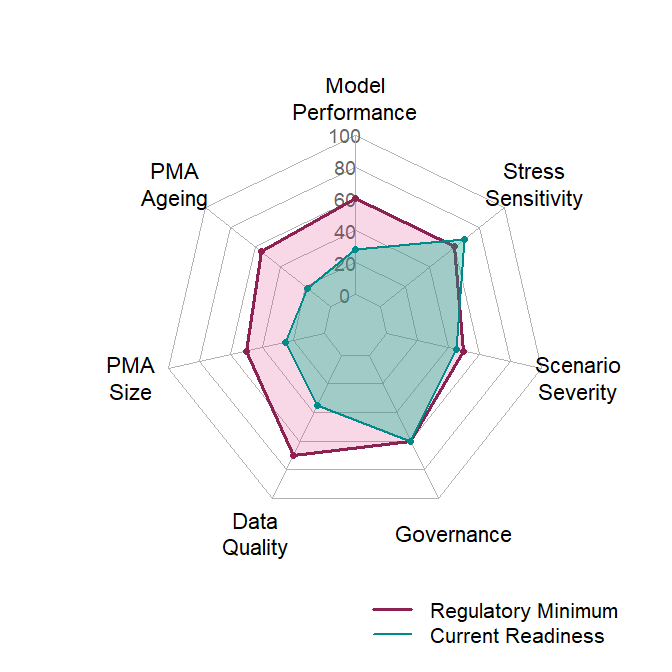
The Regulatory Readyness
-
Post Model Adjustments (PMA) Supervisors like the HKMA and the PRA expect PMAs to be temporary, evidence-based, and granular — any overuse, persistence without remediation and materiality in top-down portfolio overlays will attract challenge.
-
Significant Increase in Credit Risk (SICR) The 30-Days-Past-Due (DPD) backstop used in SICR engines should not be used in isolation, but in conjunction with forward-looking indicators. Moreover, refinancing risk; arising from borrower cliff effect as fixed-rate debt expires and refinances at higher rates; should be modelled explicitly.
-
Scrutinized Sectors and Portfolios Portfolios in vulnerable sectors — particularly Commercial Real Estate and SME lending — are subject to targeted review, with granular monitoring of debt-service-coverage ratios and covenant adherence.
-
Capture of Macro Spikes in ECL Transmission Models that smooth out macroeconomic spikes mask the non-linear effects of inflation, geopolitical volatility, and rapid interest-rate cycles on defaults. Supervisors increasingly use back-testing and transition-matrix analysis to detect smoothing: ECL that fails to move under a severe scenario is itself a red flag.
-
Supervisory Stress Testing Stress‑Testing the ECL is used as a tool in regulatory testing to examine the what if impact on capital. The standard IFRS-9 calculation already incorporates a range of scenarios with weights. However, the framework must be ready to respond to scenarios beyond the standard probability-weighted range.
-
Validating the ECL framework Model credibility under stress is demonstrated through technically sound in-house validation. Where stressed ECL diverges materially from base ECL, banks must be able to explain the divergence — this is the reconciliation test that supervisors now apply.
-
Transparent Data Lineage Data lineage in IFRS9 computations is expected to be traceable through to the ECL engine to verify timeliness and integrity of data.